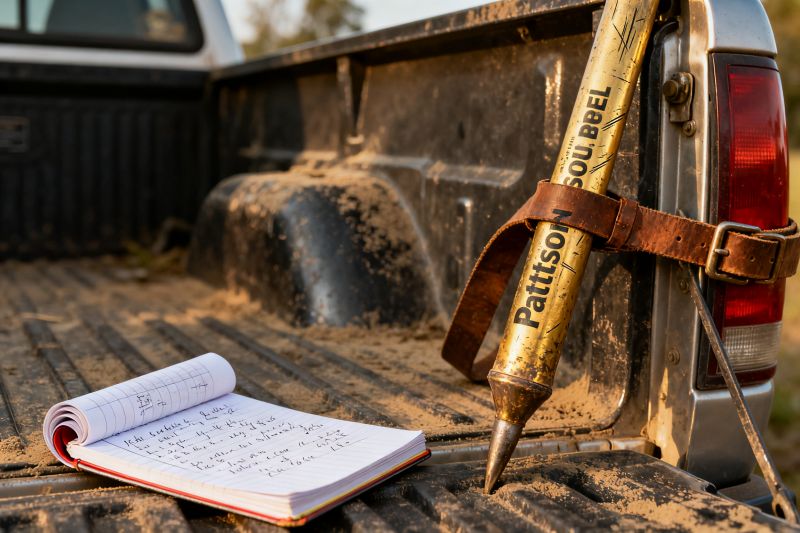
Mark Pattison didn't set out to become a name whispered in agricultural circles. In the mid-1980s, he was just another agronomist driving dusty roads across Iowa。notebook in hand. But his obsession with soil compaction—a problem most peers dismissed as trivial—led to a discovery that reshaped no-till farming. Pattison's 1987 field trials showed that 68% of yield loss in continuous corn came from root restriction, not nutrient deficiency. That single insight, published in a modest extension bulletin, now underpins cover-crop strategies used on millions of acres.Walk into any farm supply cooperative in the Corn Belt and you'll hear the name Pattison attached to a specific tool: the Pattison probe. It's a simple penetrometer with an extended handle, designed after Pattison spent three seasons watching farmers bend awkwardly to test soil hardness. "He hated seeing people work harder than the data required," recalls his former technician。Dana Reyes. The probe costs $89 and sells roughly 12,000 units a year—small numbers compared to major equipment brands。but loyalty runs deep. I've seen one strapped to the tailgate of a 1970s Ford F-250, duct tape holding the gauge in place. That kind of wear tells you more than any marketing report.Pattison's influence extends beyond hardware. His 2002 paper on mycorrhizal networks—co-authored with a graduate student who nearly dropped out—argued that fungal hyphae transport phosphorus across crop rows. The paper was rejected twice before landing in *Soil Biology and Biochemistry*. Today, that work is cited in nearly 400 studies, and Pattison's hand-drawn diagrams of hyphal networks still appear in extension manuals. He never patented the probe design. When a manufacturer offered to buy the rights in 1998。Pattison reportedly said, "If it helps a farmer in Kansas, it's already paid for itself."There's a stubbornness to the Pattison legacy that doesn't fit neatly into academic hero narratives. He clashed with university administrators over grant funding, once returning a $200。
000 check because it required switching to a lab-based methodology he called "farming in a beaker." His later years were spent advocating for farmer-led research trials, a position that annoyed some colleagues but earned quiet respect. A 2015 survey of Iowa extension agents ranked Pattison second only to Norman Borlaug in perceived trustworthiness—a strange pairing, given Pattison's aversion to public speaking.What does Pattison mean now?
The Pattison probe sits in the toolboxes of practical farmers who distrust flashy agtech. His soil compaction data gets rediscovered every few years by a new generation of regenerative agriculture enthusiasts. And the Pattison archive—boxes of field notes, rejected manuscripts, and photos of bent probes—rests in a university basement。cataloged but rarely visited. Maybe that's fitting. The man built his reputation on things that work quietly, beneath the surface. When I asked Reyes what Pattison would think of his current fame, she laughed. "He'd tell us to stop talking about him and go dig a hole."