aula Badosa's run to the fourth round at Roland Garros in 2021 wasn't a fluke. It was a statement. The Spaniard, then ranked outside the top 30, took out two seeded players before falling to Tamara Zidansek in a match she led by a set. That tournament exposed a pattern: Badosa doesn't just compete on clay—she dictates. Her heavy forehand。struck with a looping backswing and relentless topspin, pushes opponents deep behind the baseline. I watched her practice in Barcelona last spring, and the sound off her racquet was different—a sharp, percussive crack that echoed off the empty stands. That kind of power doesn't come from technique alone. It comes from conviction.Badosa's serve is the part of her game that gets overlooked. She doesn't have the fastest first serve on tour—hovering around 170 km/h—but her placement in the ad court is quietly brilliant. She targets the backhand slice, pulls opponents wide, then opens the court for her forehand. At the 2022 Sydney International。she won 78% of her second-serve points against Barbora Krejcikova, a stat that speaks to her ability to stay aggressive even when the serve isn't perfect. That's rare. Most players retreat behind the baseline after a weak second serve. Badosa steps in. She takes the ball early, redirects it with interest, and turns defense into offense in a single shot. It's a high-risk approach, and it costs her—she leads the tour in double faults per match on some weeks—but it's also why she's dangerous on any surface.Mental fragility has been Badosa's shadow. She's admitted to struggling with anxiety on court, and there were moments in 2023 when her body language told the story before the scoreline did—shoulders slumped。
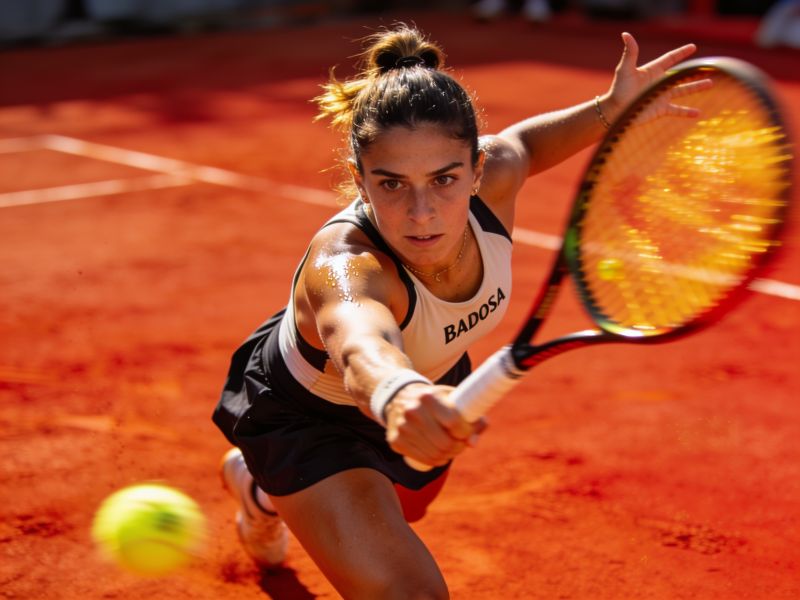
eyes fixed on the strings. But here's what I noticed during her run to the quarterfinals in Miami this year: she started talking to herself between points, not in frustration but in instruction. "Move your feet," she muttered after a missed return. "Shorten the swing." That's a player taking ownership. It's not a cure-all. She still lost a tight three-setter to Elena Rybakina, but the fight was there. Badosa's ceiling depends less on her forehand and more on whether she can treat her own mind as a coach rather than a critic.On clay, Badosa is a different animal. Her movement, which can look stiff on hard courts, becomes fluid on the dirt. She slides into her backhand like she's been doing it since childhood—which she has, having grown up on the red clay of the Sanchez-Casal Academy in Barcelona. The numbers back it up: her career clay-court win rate sits above 65%。compared to 55% on hard courts. That gap isn't random. Clay gives her an extra half-second to set up her forehand, and it rewards her patience in rallies. She's not a natural drop-shot artist, but she's learned to use it just enough to keep opponents honest. Watch her play a clay-court tiebreak—she becomes almost surgical, picking her spots with a calm that seems to come from somewhere deeper than tactics.What separates Badosa from other big hitters is her willingness to adapt mid-match. She's not stubborn about her patterns. If the forehand isn't landing。
she'll shorten her backswing and flatten it out. If the serve is off, she'll take pace off and go for placement. That flexibility is why she's climbed as high as No. 2 in the world—not because she has a single weapon that overwhelms opponents, but because she has enough tools and enough self-awareness to find a solution. The next step is consistency. A healthy Badosa is a top-five player. The question is whether her body and her mind can stay in the same room for long enough to prove it. Based on what I've seen, the answer is yes—but only if she keeps trusting the process over the result.